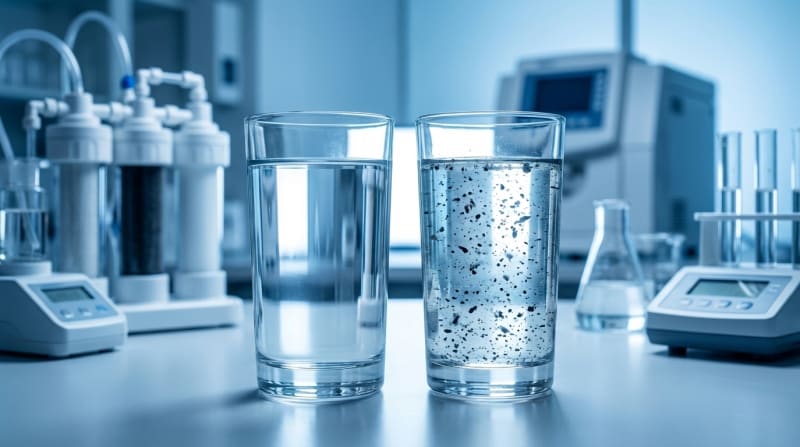

Water quality is a Your Money or Your Life topic for good reason: the substances dissolved in your supply matter to your household's health over the long term. The regulatory standards in California are among the strictest in the country, and the supply that arrives at most Orange County homes is, by every regulatory measure, safe. The case for treatment is incremental rather than emergency. This guide explains what's actually in OC water, what the EPA and California State Water Resources Control Board regulate, and where treatment moves the needle.
What's in Orange County tap water
The Consumer Confidence Reports from the major Orange County utilities (Mesa Water, Irvine Ranch, Santa Ana, Newport Beach Utilities, and the Metropolitan Water District wholesale system) all show a similar profile, with neighborhood variations. Hardness that averages roughly 190 to 310 ppm in most cities, which is very hard. Chloramines at 1 to 4 ppm as residual disinfectant. Total dissolved solids around 350 to 500 ppm. Disinfection byproducts (trihalomethanes, haloacetic acids) at levels below EPA limits but detectable. PFAS at low parts per trillion, attributable to the Santa Ana River contribution to the groundwater basin.
None of these numbers exceed regulatory thresholds in the utility-distributed water. Localized exposure can vary at the home level due to internal plumbing contributions, particularly in pre-1986 housing stock where lead solder and brass fixtures contribute to first-draw lead readings.
PFAS: what they are and what changed in 2024
Per- and polyfluoroalkyl substances, the "forever chemicals", are a class of over 12,000 synthetic compounds with extreme environmental persistence. They've been linked through epidemiological studies to kidney and testicular cancer, thyroid disease, immune system suppression, reproductive harm, and elevated cholesterol. In April 2024, the EPA finalized the first federally enforceable drinking water standards for six PFAS compounds: PFOA and PFOS at 4 parts per trillion each, PFHxS, PFNA, and HFPO-DA at 10 ppt each, with a Hazard Index of 1.0 for mixtures.
Public water systems must complete initial monitoring by 2027 and implement treatment to comply with the MCLs by 2029 (with a proposed extension to 2031 announced in May 2025). For Orange County specifically, OCWD has documented PFAS in the groundwater basin and estimates compliance costs at approximately $1.8 billion over thirty years across regional water agencies. For homeowners, the practical implication is that municipal-supply water meets compliance at the utility level, and point-of-use reverse osmosis at the kitchen reduces residual exposure to non-detect levels.
Lead and copper from internal plumbing
Lead in water is almost never a utility-side issue in modern California; the utility-distributed water meets the EPA action level of 15 micrograms per liter consistently. The contribution to first-draw water at the kitchen tap comes from the home's internal plumbing: lead solder used in copper joints before 1986, brass fittings (which contained up to 8 percent lead until 2014), and lead service lines on a small number of older properties.
The single most useful diagnostic is a paired water test at the kitchen tap (first-draw, after a six-hour stagnation) and at the outside hose bib. The two samples bracket the contribution of the home's plumbing. For homes built before 1986, expect some elevation at the kitchen tap; the appropriate response is point-of-use reverse osmosis at drinking water locations, which reduces lead by 96 to 98 percent.
Hardness: not a health issue, but worth treating
Calcium and magnesium dissolved in water are not regulated as health concerns. The EPA does not set a maximum contaminant level for hardness because the science doesn't support one; in fact, hard water contributes a small amount of dietary calcium and magnesium to the diet.
The case for treating hardness is practical, not health-related: scale on appliances, reduced soap performance, dry skin and dull hair after bathing, mineral spotting on glassware and shower doors, and shortened lifespan on water-using equipment. A salt-based softener removes hardness by ion exchange, replacing calcium and magnesium with a small amount of sodium (typically 7.5 mg per 8-ounce glass on Orange County water). For homeowners on sodium-restricted diets, a kitchen RO bypass or whole-home potassium chloride softener addresses the concern; for most households the trade-off is unambiguously favorable.
Post-wildfire water concerns
Wildfires in Southern California have created water-quality concerns that didn't feature prominently before. Damaged plastic service lines and meters can leach volatile organic compounds (notably benzene) into the water supply for months after a fire event. Ash and debris runoff carries heavy metals, nitrates, and particulates into reservoirs and groundwater sources. Even after utilities issue safe-to-drink notices, localized contamination within a property's plumbing can persist if lines were heat-damaged.
Post-wildfire water testing should be comprehensive: VOCs (especially benzene, toluene, xylene), heavy metals (lead, copper, arsenic, chromium), disinfection byproducts (which spike when utilities increase chlorination after fires), turbidity, and total dissolved solids. The appropriate treatment response depends on what's found; activated carbon for VOCs, RO for heavy metals and dissolved solids, sediment filtration for turbidity. For affected communities, our team provides complimentary post-fire consultations.
How to test your water
The most useful diagnostic is a comprehensive panel from a state-certified laboratory: hardness (total and calcium), TDS, pH and alkalinity, chloramines, lead and copper at first-draw and post-flush, iron and manganese, nitrates and nitrites, total coliform and E. coli, and (for an additional fee) PFAS at low-detection limits. Cost: $150 to $400 for the standard panel, $200 to $400 additional for PFAS-specific testing.
Order the test before specifying any treatment system. The lab report defines the treatment problem; without it, system selection is guesswork. The 10 to 14 days of laboratory turnaround is well-spent compared to the cost of an undersized or mis-specified system installed without diagnostic data.
Sources and further reading
- U.S. EPA, Per- and Polyfluoroalkyl Substances (PFAS) drinking water regulation
- Orange County Water District, PFAS
- U.S. EPA, Basic Information about Lead in Drinking Water
- U.S. EPA, Use of Lead Free Pipes, Fittings, Fixtures, Solder, and Flux for Drinking Water
- U.S. EPA, Chloramines in Drinking Water
- Irvine Ranch Water District, annual water quality report
- City of Santa Ana, water quality consumer confidence report