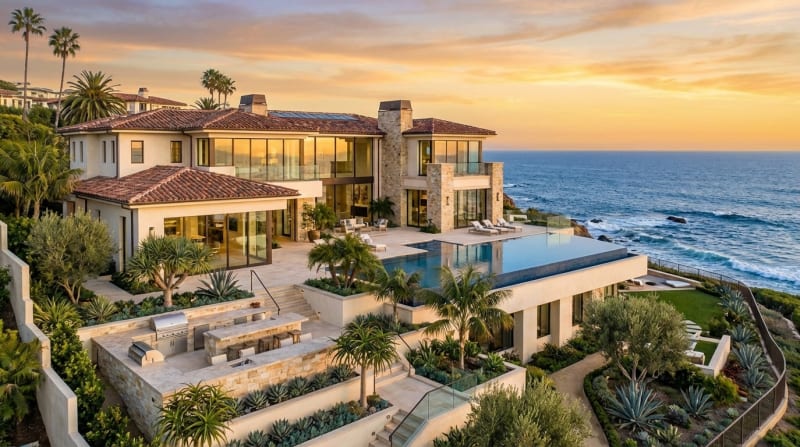

Estate-scale water systems are not larger versions of standard residential equipment. The flow rates, the simultaneous demand, the integration with smart home platforms, and the coordination with the architect and builder all change the design problem. Done well, the result is a treatment system that disappears into the home and works for fifteen to twenty years without surprise. Done poorly, it produces undersized capacity, awkward service access, and a constant low-grade dissatisfaction with water quality. This guide is the reference for getting custom estate work right in Orange County.
Why custom design matters at estate scale
A custom luxury home has water demand patterns that builder-grade equipment isn't designed to handle. Multiple bathrooms running simultaneously during the morning routine. Outdoor irrigation at twenty zones across landscape, garden, and lawn. Pool fill and water-feature makeup. An outdoor kitchen with prep sinks and ice production. A guest house with its own demand profile. The peak simultaneous flow can exceed 30 gallons per minute on properties where the average home runs 8 to 12 GPM.
An off-the-shelf system sized for a generic four-person household will deliver water that's technically softened but has measurable pressure drop during peak demand, regenerates more often than designed, and reaches end-of-life inside a decade. A properly sized custom system runs in spec for its full design life and delivers the water-quality experience the rest of the home was designed to provide.
Coordinating with the architect and builder
The right time to bring water treatment into a custom home design is at the schematic phase, when the architect is still negotiating the equipment room footprint and the location of the main water service entry. Decisions made then cost effectively nothing; the same decisions made after framing or after move-in cost five-figure corrections.
A well-coordinated schematic-phase plan addresses four things: equipment room sizing (24 to 40 square feet of conditioned floor for the treatment stack alone, with a floor drain rated for regeneration discharge); main service line sizing (1.25 to 1.5 inches for most estates, sized to support peak simultaneous demand); rough-in plumbing distinctions (RO water at the kitchen prep sink and refrigerator, softened water at fixtures, often raw water at the irrigation zones to avoid sodium loading on plants); and electrical provisions (clean GFCI circuit near the equipment room for smart controllers and booster pumps).
What a custom design includes
The full stack for an Orange County estate typically runs sediment pre-filtration, catalytic carbon for chloramines, salt-based softening sized to actual hardness and demand, point-of-use reverse osmosis at the kitchen and refrigerator, and smart monitoring and shut-off at the main supply. For homes in older neighborhoods with original plumbing, we add a polyphosphate dosing stage to manage corrosion. For homes on private wells, we add iron and manganese pre-treatment and UV polish.
Each component is sized to the home's lab report and demand profile, not to a catalog default. A 96,000 grain softener instead of a 48,000 grain unit. A 2.5 cubic foot carbon tank instead of 1.5. RO with a permeate pump and 3-gallon storage instead of a 1-gallon basic configuration. The marginal cost of right-sizing is 10 to 25 percent over the standard package; the difference at the tap, ten years later, is the difference between a system the homeowner forgets about and one they think about every week.
Coastal vs inland considerations
Coastal Orange County properties (Newport Beach, Corona del Mar, Laguna Beach, Dana Point) have an additional design factor: salt air corrosion on equipment housings and fittings. Standard galvanized steel housings rust within five years near the coast; we specify epoxy-coated or stainless equivalents for coastal projects. The cost premium is modest; the longevity benefit is significant.
Inland properties (Santa Ana, Anaheim Hills, Yorba Linda, parts of Irvine) have different priorities. Higher ambient temperatures in the equipment room can affect membrane life if ventilation is poor. The water profile sometimes carries more sediment from infrastructure age. We design for these conditions specifically rather than treating all of OC as one geographic case.
Smart monitoring integration
Modern luxury homes increasingly run on integrated platforms (Crestron, Lutron, Control4, Apple Home, Google Home). A water treatment system that can't talk to the rest of the home's intelligence becomes an island, requiring its own app and its own attention.
The right approach for an integrated estate is to specify treatment equipment with API access or platform-native integrations, allowing the home's management interface to display status, send alerts, and trigger actions. Smart shut-off in particular benefits from integration: a leak alert that reaches the homeowner via the same channel as a security alert is acted on faster than one that arrives via a separate app the homeowner may not check while traveling.
Project examples
The shape of estate water work varies project to project. A 1920s Spanish Revival in Floral Park, where the install required a custom-fabricated equipment closet behind the laundry and concurrent service-line replacement. A 2018 contemporary in Park Santiago, where the system integrates with the smart home platform for remote monitoring across multiple stages. A 1960s ranch on Santa Ana's east side, where the entire copper service was replaced in coordination with the system install. Each project required a different design path; the underlying principles (sized to the lab report, integrated with the home, serviceable for fifteen years) were the same.
Our practice file from the Aerie Villas project in Corona del Mar shows what comprehensive estate-scale work looks like at multi-residence development scale: vertically stacked equipment arrays in dedicated utility closets, sound-dampening enclosures, point-of-use RO pre-plumbed during rough-in, and corrosion-resistant fittings throughout for the coastal exposure. Read more in our Aerie Villas project announcement.